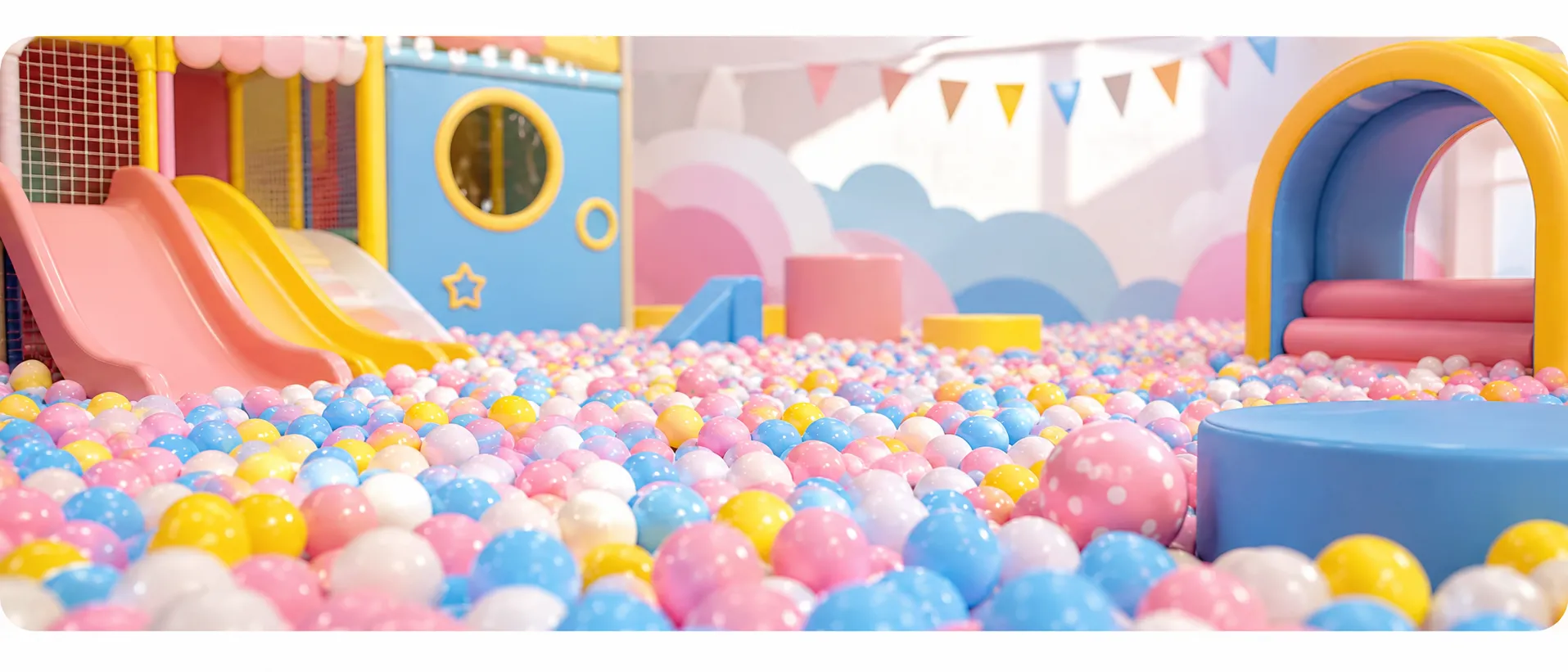
ATX develops commercial ball pit equipment for indoor play centers, shopping mall atriums and family entertainment venues. Rather than treating a ball pit as an isolated pool of plastic balls, our showcased Atrium Series integrates large ball pool areas with themed structures and recreational features, creating a coordinated indoor play environment.
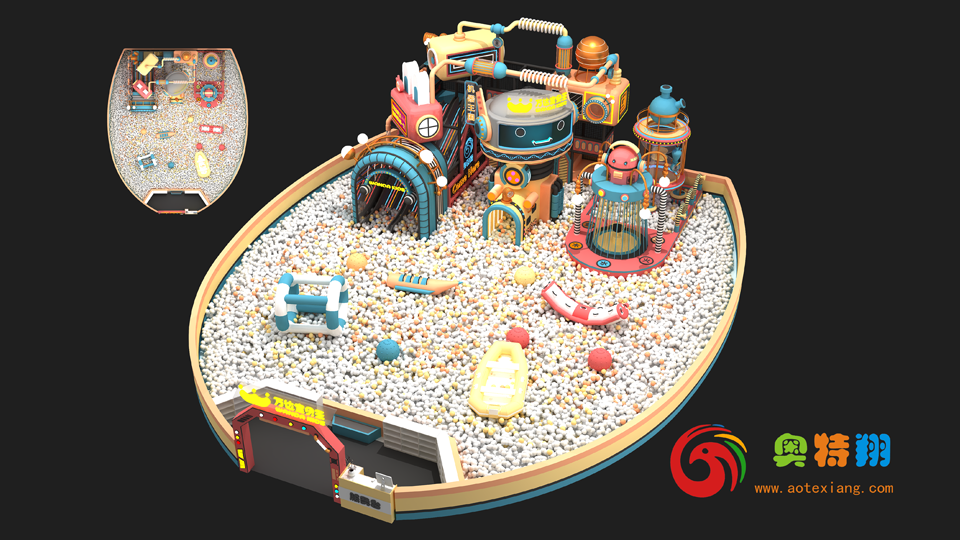
ATX Atrium Series design visualization showing a large integrated ball pool.
The Atrium Series demonstrates large indoor ball pools designed as part of themed recreational spaces, with surrounding play elements and venue-specific layout arrangements.
Project focus: Shopping malls and indoor entertainment venues
Layout: Ball pool combined with themed play features
Design review: Site dimensions, access and circulation
Configuration: Based on the selected project design
Explore ATX Atrium Series Ball PoolFor commercial buyers: ATX's published ball pit designs vary in theme and arrangement. Final pool dimensions, ball specifications, surrounding structures and operating capacity should be confirmed for each project rather than assumed from concept images.
Ball pit dimensions affect more than the amount of space occupied by the enclosure. The usable pool area, ball fill depth, access design and quantity of balls all influence the proposed layout. Before confirming an indoor ball pit order, the pool geometry and intended user group should be evaluated together.
Confirm usable internal length and width, rather than relying only on the overall external footprint.
Select a suitable ball depth according to the intended age group, equipment design and safety assessment.
Verify the ball diameter, material and age suitability before estimating the total quantity.
Capacity requires a separate assessment of age groups, supervision, access and the complete play layout.
A preliminary quantity estimate can be made using the usable pool volume, selected ball diameter and an allowance for the spaces between packed balls. The calculation below is an illustration only, not an ATX model specification or a safety-approved fill depth.
Length x Width x Fill Depth
Use internal measurements and exclude space occupied by fixed structures or other obstructions.
Estimated Ball Count =
Fill Volume x Packing Factor / Single Ball Volume
Ball size and packing behavior affect the estimate; the final fill quantity should be checked against the approved project design.
Assume an unobstructed pool measuring 4 m x 5 m, a proposed fill depth of 0.35 m, balls of 80 mm diameter and an illustrative packing factor of 0.60.
The fill volume is 7 m³. Under these assumptions, the approximate quantity is 15,700 balls.
This is a mathematical planning example, not a recommended fill specification or maximum occupancy. Actual ball quantities vary with ball dimensions, pool shape, obstructions and the approved design.
For a custom commercial ball pool, provide the site drawing and intended user group so ATX can review the enclosure layout, proposed fill and suitable ball specifications.
A commercial ball pit is a coordinated assembly of plastic balls, an enclosure, padded surfaces, entrances and supporting components. When reviewing equipment specifications, buyers should examine how these components work together, how they can be inspected and how damaged parts can be replaced.
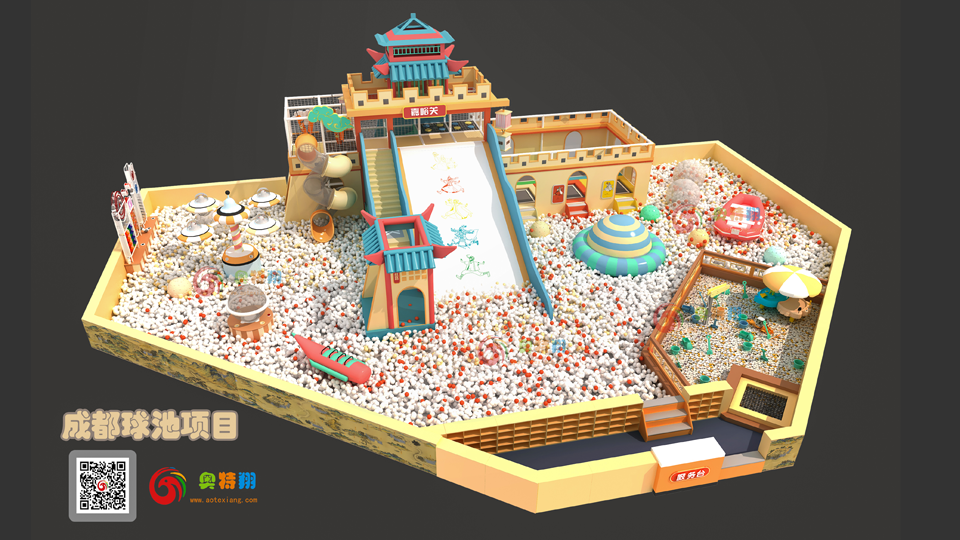
ATX design visualization showing a themed ball pool with surrounding play and access areas.
Pool walls help retain balls within the intended play area, while padded boundaries and appropriate entry points form part of the overall user environment. Buyers should review the enclosure together with the planned play features and operator supervision arrangements.
Check ball diameter, material, surface condition, age suitability and available material or product test information. Confirm how damaged or unsuitable balls should be replaced.
Review enclosure height, padding materials, edge treatment, structural stability and connections with adjacent play equipment.
Evaluate the proposed floor system, its compatibility with the surrounding structure and its accessibility for cleaning, inspection and maintenance.
Plan appropriate entrances and exits, visibility for staff, movement around the pool and the ability to reach different parts of the play area.
Consider how balls are kept within the designated zone and how they can be collected, removed, cleaned and returned without disrupting surrounding equipment.
A large ball count does not automatically mean a suitable commercial play facility. Pool dimensions, ball specifications, containment, padding, access and the full equipment layout must all be reviewed. ATX should confirm the available configuration and product-specific documentation for each project.
A commercial ball pool contains a large number of frequently handled balls, making cleaning access and maintenance part of the equipment planning process. Venue operators should establish procedures for checking the balls, inspecting the padded enclosure and responding to contamination before the play area opens to customers.
Check for visible contamination, damaged balls and enclosure defects.
Remove affected balls or empty the area when the cleaning procedure requires it.
Use cleaning or sanitizing procedures appropriate to the ball and surface materials.
Allow items to dry as instructed and check their condition before reuse.
Replace unsuitable balls and confirm that the play area is ready for operation.
Ball removal: Consider how staff will collect or move a large quantity of balls for cleaning.
Material compatibility: Verify which cleaning agents and methods are suitable for the supplied balls, padding and enclosure materials.
Incident response: Establish procedures for contamination and temporary closure when necessary.
Maintenance records: Document inspections, cleaning and replacement of damaged equipment.
Hygiene reference: The CDC guidance on cleaning and disinfecting children's environments provides general principles for cleaning play surfaces and toys. It is not a product-specific ball pit cleaning manual. Operators should also follow the equipment manufacturer's instructions and applicable local requirements.
In commercial indoor playgrounds, a ball pit may form part of a wider activity layout rather than a separate room. Slides, climbing features, themed structures and adjacent play areas must be coordinated so the ball pool does not interfere with access, circulation, inspection or supervision.
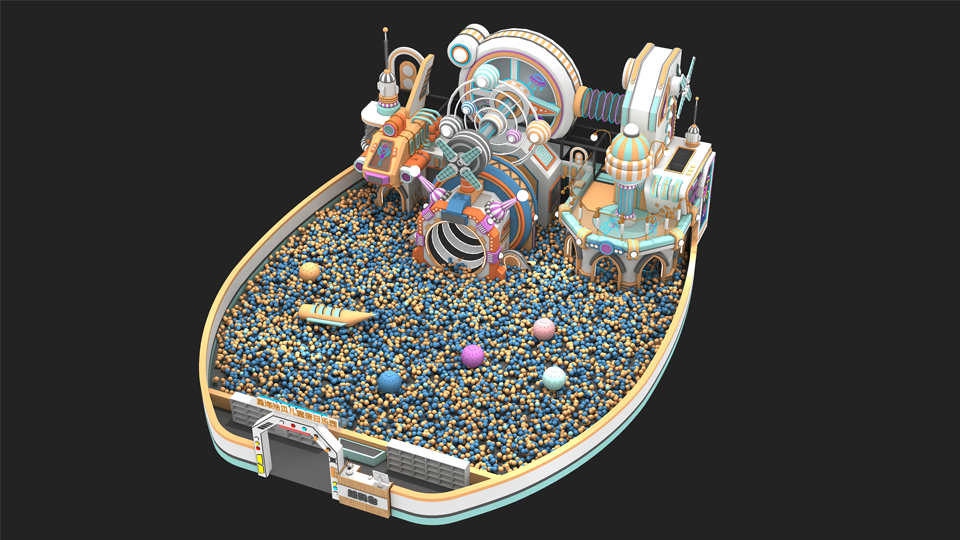
ATX indoor ball pool design with integrated themed equipment and surrounding activity space.
01 / Slides: Coordinate slide landing areas and ball pool access with the equipment-specific requirements.
02 / Soft Play: Review padding, boundaries and transitions where ball pits connect with other play features.
03 / Supervision: Maintain suitable staff sightlines and access to all intended activity zones.
04 / Maintenance: Allow staff to access floor surfaces and remove balls without dismantling unrelated equipment.
For projects covering a complete indoor venue, explore ATX indoor playground equipment and indoor soft play solutions.
ATX's published Gorilla-Themed Indoor Playground project describes an approximately 300 m² indoor recreation space with an 8 m overall venue height. The project combines multiple attractions, including slides, trampolines and a colorful ball pit.
The example illustrates how a ball pit can be incorporated into a larger themed play environment. The 300 m² figure refers to the overall project, not the ball pool itself; individual ball pit dimensions are not specified in the published description.
View the Gorilla-Themed Indoor Playground ProjectA useful commercial ball pit quotation should define the pool structure, ball specifications, surrounding equipment and the agreed scope of supply. Shopping mall developers, entertainment operators and playground contractors can prepare the following information before requesting a custom design or equipment proposal.
| Quotation Item | Information to Prepare |
|---|---|
| Project Type | Shopping mall atrium, indoor play center, family entertainment venue or other commercial application. |
| Available Space | Site plan, available length, width, ceiling height, columns, access and surrounding restrictions. |
| Ball Pool Layout | Preferred pool shape, approximate dimensions, intended play activities and surrounding equipment. |
| Ball Requirements | Proposed ball size, material, color scheme and fill requirements for project review. |
| Enclosure & Padding | Boundary arrangement, floor construction, access points and protective material requirements. |
| Intended Users | Target age groups, operating conditions and expected supervision arrangements. |
| Technical Documents | Product drawings, applicable test information, installation guidance and maintenance documentation. |
| Delivery Scope | Destination country, project schedule, packing, shipping terms and responsibilities for installation. |
Commercial indoor play structures may be subject to applicable soft contained play equipment requirements, depending on the equipment design and destination market. Buyers should confirm which standards apply to their specific ball pit or integrated playground layout.
For reference, see ASTM F1918 - Soft Contained Play Equipment. Referring to a standard does not establish certification of every ATX product. Ask for documentation applicable to the proposed equipment.
Commercial ball pit quotations depend on the enclosure dimensions, ball specifications and quantity, wall and floor construction, themed design, additional play components and project delivery requirements. Buyers should request a clearly defined equipment list and supply scope rather than comparing prices by ball count alone.
Practical answers for indoor playground buyers, shopping mall developers and family entertainment center operators.
ATX showcases large indoor ball pool arrangements through its Atrium Series, including designs with themed structures and surrounding play features. Buyers can review the Atrium Series product page and discuss the configurations available for their venue.
ATX presents customized indoor playground layouts, including large ball pool designs. Buyers should provide a site plan, usable dimensions, intended age groups and preferred play features. The proposed ball pit size, enclosure and integrated equipment can then be reviewed against the project requirements.
The required quantity depends on the usable pool volume, approved fill depth, ball diameter and space occupied by internal structures. A mathematical estimate can help with preliminary planning, but the final order quantity should be confirmed from the selected ball specifications and the approved pool layout.
Ball diameter and fill depth must be selected in relation to the intended users, equipment design and applicable safety requirements. There is no single specification suitable for every commercial ball pit. Buyers should verify the proposed ball material, dimensions, age suitability and fill arrangement before approving an order.
Commercial buyers should review the proposed boundary structure, padded surface materials, floor protection, fastening details and cleaning compatibility. The enclosure should be evaluated as part of the complete equipment layout, including access, visibility and adjacent play areas.
Operators should establish regular inspection and cleaning procedures, remove damaged or contaminated balls, and use cleaning or sanitizing methods compatible with the supplied materials. Cleaned items should be dried according to product instructions before reuse. Maintenance procedures should also cover the enclosure, padding and surrounding play surfaces.
Yes. ATX's published indoor playground designs demonstrate ball pool areas integrated with themed structures and other play attractions. Each connection should be reviewed for suitable access, supervision, protective surfaces and equipment-specific requirements. The final arrangement depends on the selected project design.
Provide your venue type, site dimensions, intended age groups, approximate pool size, preferred design and destination country. If the ball pit will connect to slides or other equipment, include those requirements as well. A drawing or reference image can help ATX review the proposed configuration and quotation scope.
Tell ATX about your available space, intended users, ball pool configuration and project requirements. Contact our team to request a project-specific commercial ball pit quotation.